

Writing Room
According to Strawson, life is experienced in a “diachronic” or “episodic” kind of way: the former is compatible with psychological narrativity, the latter not.
This is the first of four related blog posts:
Part I | Part II | Part III | Part IV
Granted, I’m not an avid fan of Galen Strawson; first of all, I certainly agree with him that there is no free will as we know it, but I remain rather unconvinced by his approach. Daniel Dennett’s approach leaves much to be desired either, but I remember that I found Strawson’s take on Dennett in the New York Times rather curious in its effort to procrustify Dennett’s valid points into the bed of his own theory.
Now, Strawson is also a literary critic, and against the backdrop of his metaphysics it shouldn’t come as a terrible surprise that certain ideas developed in, or derived from, cultural/literary theory are not entirely to his taste. One of these ideas is what he calls the “psychological Narrativity thesis,” a concept he takes on with both barrels in “Against Narrativity,” published in Ratio (New Series) XVII, 4 Dec 2004.
“Both barrels” also means that Galen Strawson not only attacks the descriptive thesis, i.e., that we construct ourselves and our lives like a narrative (Sacks, Bruner, Dennett), but also, thankfully, the normative approach that we “ought to understand our lives as an unfolding story” by e.g., Templeton Prize winner (yes indeed) Charles Taylor, whose 600 pages of unabashed Neo-Platonism in Sources of the Self: The Making of the Modern Identity still makes my tears fall, my eyes roll, and my brain fall out.
The interesting thing is, though, that Strawson differentiates in his essay two fundamentally different types of people: those who experience life in a “diachronic” kind of way, which is compatible with the concept of psychological narrativity, and those who experience life in an “episodic” kind of way, which isn’t:
One has little or no sense that the self that one is was there in the (further) past and will be there in the future, although one is perfectly well aware that one has long-term continuity considered as a whole human being. Episodics are likely to have no particular tendency to see their life in Narrative terms.
This is fascinating, and in two or more upcoming collateral tales posts I’d like to examine it from several angles: the basic assumptions of, and the evidence for, Strawson’s theory; a case from my own circle of friends who might fit the “Episodics” bill; and how this concept of episodicity might be another form of narrativity in disguise which also, perchance, could be, or already is, a powerful writing technique in its own right.
Concerning Comments
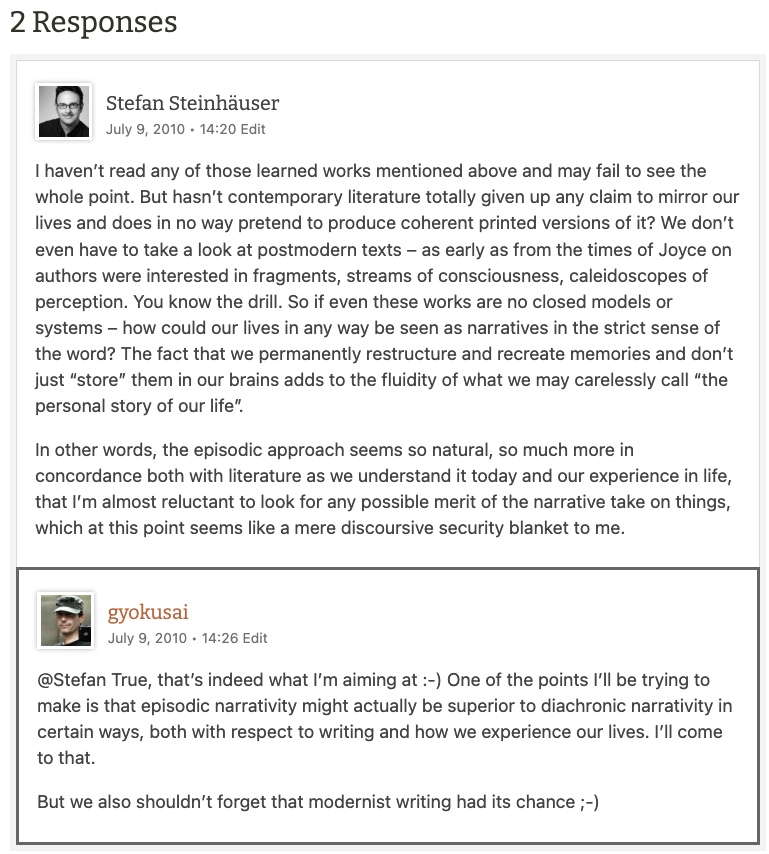
While I disabled comments ages ago, I preserved legacy comments. However, as each page with active comments throws a critical error for inexplicable reasons—even with all plugins deactivated—I attached all legacy comments as images with ALT texts instead.

If you have something valuable to add or some interesting point to discuss, I’ll be looking forward to meeting you at Mastodon!