
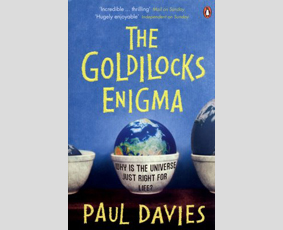
The Goldilocks Enigma by Paul Davies
There was some serious grinding-of-teeth involved in reading this book.
While Paul Davies is often very good at explaining complicated matters in easy terms and interesting ways, this text became quickly unbearable on account of his dubious metaphors and his metaphysical pandering.
If you think Davies just pocketed his Templeton Prize and went on to do science, well, read no further than page 5 to dispel this notion:
The ancients were right: beneath the surface complexity of nature lies a hidden subtext, written in a subtle mathematical code. This cosmic code contains the secret rules on which the universe runs. Newton, Galileo and other early scientists treated their investigations as a religious quest. They thought that by exposing the patterns woven into the processes of nature they truly were glimpsing the mind of God. Modern scientists are mostly not religious, yet they still accept that an intelligible script underlies the workings of nature, for to believe otherwise would undermine the very motivations for doing research, which is to uncover something meaningful about the world that we don’t already know.
This constitutes a formidable example of Jesuit rhetoric, because nothing is actually wrong here—but it syntactically juxtaposes things which are certainly not on a par, and the fallacy is brought about in the mind of the reader by being nudged, not only into the thought that the religious and the scientific endeavor are more or less the same, but that religion can draw legitimization out of the scientific endeavor. Some bridge building, I’d say. The bulk of the book, after that, contains interesting observations and explanations of the cosmos as we know it and certain aspects of particle physics. But toward the end, teeth-grinding comes back with a vengeance.
Davies actually manages, once again with a rhetorical slight-of-hand similar to the one above, to put a) the search for a final theory, b) the multiverse theory, and c) the designer theory on the same level—which should, as he sees it, all be succeeded by a theory of the universe that takes the existence of “mind” and the “intelligent observer” into account. All three approaches, Davies repeatedly insists, have the “turtles all the way down” problem because even if any of these approaches did work out, the question would remain, “why this theory?”; “why this multiverse construct?”; “who designed the designer?”; respectively—whereby, one should not neglect to mention, he even gives the designer theory a possible cop-out by referring to the nonsensical concept of the “necessary being” argument, a proof-of-god fabulation from ontology that has been in circulation far too long.
This argument too puts science and religion surreptitiously on the same level. It is achieved, fittingly, by creating its own row of infinite turtles “all the way down” in the form of asking ever more “why” questions—a method which seems totally innocuous and innocent and invokes childhood memories and the egregiously stupid meme that “adults have forgotten to ask,” but is actually far from being legitimate by default, and needs to be reflected upon as an epistemological strategy in the first place.
And what is Davies getting at, if he dismisses all three approaches? A self-explaining universe with backward-in-time causation (courtesy a curious non-Copenhagen interpretation of quantum theory) that revolves around the “minds” of “intelligent observers” who are being woven into the very fabric of the cosmos and create the universe in retrospect—an explanation that neatly preempts accusations of teleology because of its “loop” structure, as well as accusations of being glaringly anthropocentric by asserting that it’s not about us, humans, but “minds” and “intelligent observers” as such that’s at the heart of the cosmos.
Have “mind/intelligent observer” already been proven to be the highest form of self-awareness in the entire cosmos? Well, then I must’ve missed the message. But if you’re looking for a contemporary anthropocentric world view that makes you feel important by putting you right back into the center of the universe, then this might be for you.
Does Davis leave it at that, as egregious as it is? No. He has to go a step further. He again pulls out his straw man for the scientific position and again juxtaposes this position with another position with which it has nothing whatsoever in common, and starkly asserts that those who think that the universe has no “ultimate purpose,” and that “life” and “mind” have come about with no “reason,” would effectively throw their hands in the air and exclaim that all this is an “unfathomable mystery.” Yes, this is his argument, and it’s as dishonest and disgusting as it can possibly get.
What all this boils down to is: don’t waste your time with Paul Davies.

If you have something valuable to add or some interesting point to discuss, I’ll be looking forward to meeting you at Mastodon!